Rethink Neuroscience
#ForUs #ForOurChildren



On this page, I am developing M Theory (Metacognition Theory) — a concept that explains how a person understands themselves and their thinking processes, and through new awareness, also understands others. Within it, I am building a model based on three areas: feeling, logic, and belief. I conduct research, collect data, ask questions, design tests, and organize knowledge to better understand how people function and what allows them to maintain balance.
I am doing this for us and for our children — because I believe that we, as adults, should take responsibility for ourselves and for future generations. I invite you to participate in the research — your responses will help develop the theory and create diagnostic methods as well as approaches that support the natural regulation of these areas so they remain in balance. What we develop together will become a foundation for solutions that can be used for our children.
I do this because it is #necessary #good and #important
M Theory is a descriptive concept intended to support a better understanding of human functioning; it does not replace medical knowledge or diagnosis.
M THEORY - MODEL
Hypothesis - M THEORY (METACOGNITION THEORY)
Every person understands the world through three areas:
- Logic-based domain
- Feeling-based domain
- Belief-based domain
These are three natural ways of perceiving reality, present in every person in different proportions. They are not diseases or labels, but areas of functioning.
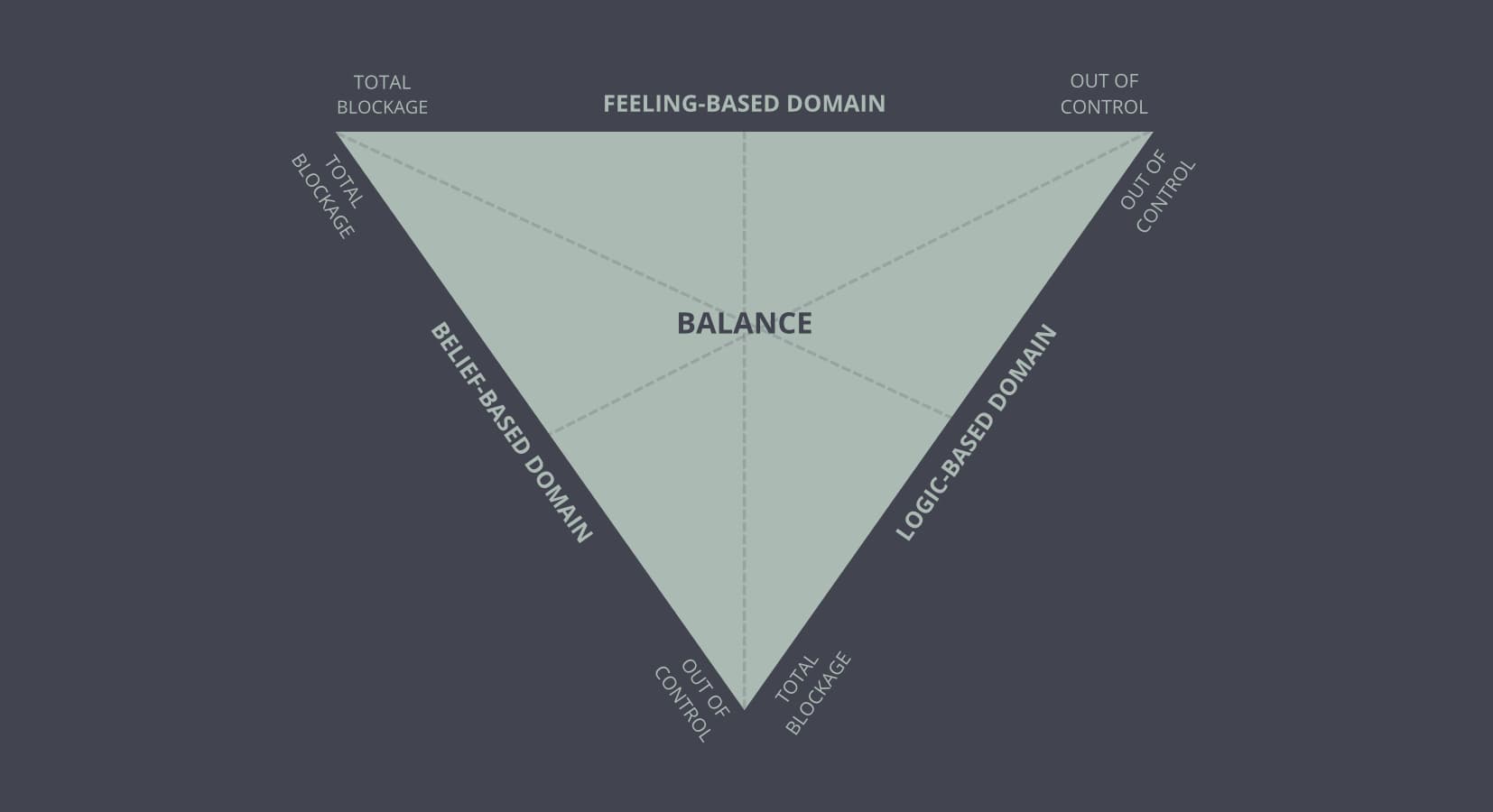
Each of these areas (logic, feeling, belief) operates on a scale:
- 0 – indicating total blockage to a given area
- max – indicating a dominant level that may go beyond our control
Conscious regulation of these areas allows us to maintain balance, understood as an optimal state, calm, or a sense of well-being.
LOGIC
FEELING
BELIEF
Hypothesis - BALANCE
We all differ in how we understand and perceive the world and ourselves. These differences result from which areas are dominant in us and how they remain in balance with one another.
This balance does not mean that everyone should function in the same way – it means the ability to consciously understand oneself.
When all three areas – feeling, belief, and logic – are within their optimal range, they create balance and support a conscious perception of the world. They allow us to make decisions in alignment with emotions, reason, and a sense of meaning.
Extreme difficulties in regulating these areas may resemble states described in psychology and psychiatry (e.g., ADHD, autism, bipolar disorder). M Theory, however, is not a diagnosis – it is a way of understanding.
Hypothesis - NEUROSTIGMA
I introduce the concept of neurostigma to science, which describes the phenomenon of oversimplifying and stigmatizing natural differences in human functioning through existing concepts and their definitions, such as ADHD, autism, or bipolar disorder. Neurostigma leads to perceiving these differences as disorders, rather than as distinct, natural cognitive profiles. As a result, these individuals may experience shame, misunderstanding, and the limitation of their own potential.